Python 网络爬虫-BeautifulSoup
Python 网络爬虫-BeautiSoup
一、BeautifulSoup 简介
简单来说,Beautiful Soup是python的一个库,最主要的功能是从网页抓取数据。官方解释如下: Beautiful Soup提供一些简单的、python式的函数用来处理导航、搜索、修改分析树等功能。它是一个工具箱,通过解析文档为用户提供需要抓取的数据,因为简单,所以不需要多少代码就可以写出一个完整的应用程序。Beautiful Soup自动将输入文档转换为Unicode编码,输出文档转换为utf-8编码。你不需要考虑编码方式,除非文档没有指定一个编码方式,这时,Beautiful Soup就不能自动识别编码方式了。然后,你仅仅需要说明一下原始编码方式就可以了。Beautiful Soup已成为和lxml、html6lib一样出色的python解释器,为用户灵活地提供不同的解析策略或强劲的速度
二、BeautifulSoup 安装
pip install beautifulsoup4pip install beautifulsoup4 -i https://pypi.tuna.tsinghua.edu.cn/simple
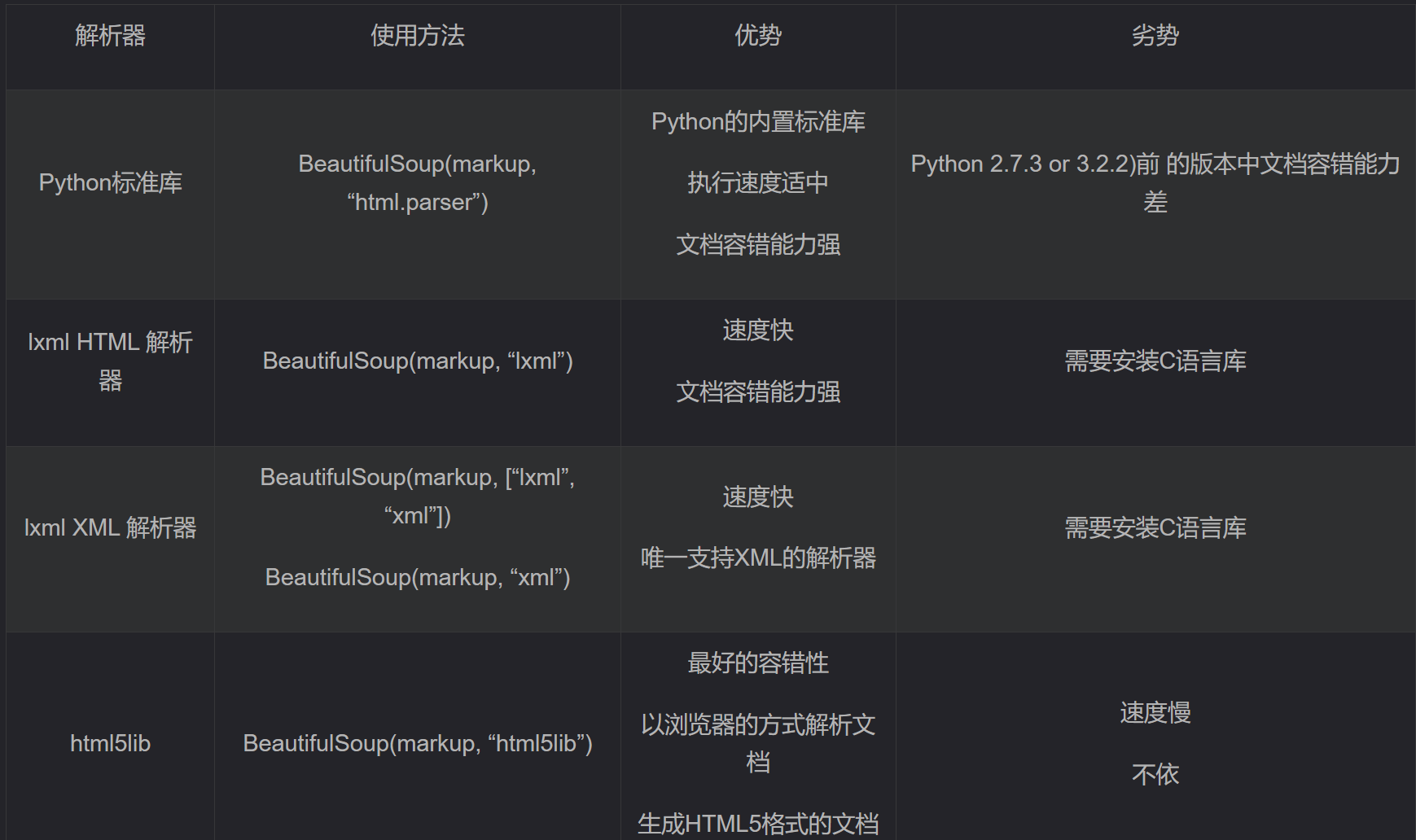
Beautiful Soup支持Python标准库中的HTML解析器,还支持一些第三方的解析器,如果我们不安装它,则 Python 会使用 Python默认的解析器,lxml 解析器更加强大,速度更快,推荐安装。
三、BeautifulSoup 使用
实例:
html_doc = """
<html><head><title>The Dormouse's story</title></head>
<body>
<p class="title"><b>The Dormouse's story</b></p>

<p class="story">Once upon a time there were three little sisters; and their names were
<a href="http://example.com/elsie" class="sister" id="link1">Elsie</a>,
<a href="http://example.com/lacie" class="sister" id="link2">Lacie</a> and
<a href="http://example.com/tillie" class="sister" id="link3">Tillie</a>;
and they lived at the bottom of a well.</p>

<p class="story">...</p>
"""
使用bs的初始化操作,创建一个BeautifulSoup对象
from bs4 import BeautifulSoup
soup = BeautifulSoup(html_doc, 'html.parser')
获取其中的某个结构化元素及其属性
soup.title  # title 元素
# <title>The Dormouse's story</title>

soup.p  # 第一个 p 元素
# <p class="title"><b>The Dormouse's story</b></p>

soup.p['class']  # p 元素的 class 属性
# ['title']

soup.p.b  # p 元素下的 b 元素
# <b>The Dormouse's story</b>

soup.p.parent.name  # p 元素的父节点的标签
# body
并不是所有信息都可以简单地通过结构化获取,通常使用 find 和 find_all 方法进行查找:
soup.find_all('a')  # 所有 a 元素
# [<a class="sister" href="http://example.com/elsie" id="link1">Elsie</a>,
#  <a class="sister" href="http://example.com/lacie" id="link2">Lacie</a>,
#  <a class="sister" href="http://example.com/tillie" id="link3">Tillie</a>]

soup.find(id='link3')  # id 为 link3 的元素
# <a class="sister" href="http://example.com/tillie" id="link3">Tillie</a
find 和 find_all 可以有多个搜索条件叠加,比如find('a', id='link3', class_='sister')
find 返回的是一个bs4.element.Ta****g 对象,这个对象可以进一步进行搜索。如果有多个满足的结果,find只返回第一个;如果没有,返回 None。
find_all 返回的是一个由 bs4.element.Tag 对象组成的 list,不管找到几个或是没找到,都是 list。
x = soup.find(class_='story')
x.get_text()  # 仅可见文本内容
# 'Once upon a time there were three little sisters; and their names were\nElsie,\nLacie and\nTillie;\nand they lived at the bottom of a well.'
x.prettify()  # 元素完整内容
# '<p class="story">\n Once upon a time there were three little sisters; and their names were\n <a class="sister" href="http://example.com/elsie" id="link1">\n  Elsie\n </a>\n ,\n <a class="sister" href="http://example.com/lacie" id="link2">\n  Lacie\n </a>\n and\n <a class="sister" href="http://example.com/tillie" id="link3">\n  Tillie\n </a>\n ;\nand they lived at the bottom of a well.\n</p>\n'
如果你有前端开发经验,对 CSS 选择器很熟悉,bs 也为你提供了相应的方法:
soup.select('html head title')
# [<title>The Dormouse's story</title>]
soup.select('p > #link1')
# [<a class="sister" href="http://example.com/elsie" id="link1">Elsie</a>]
4.四大对象各类
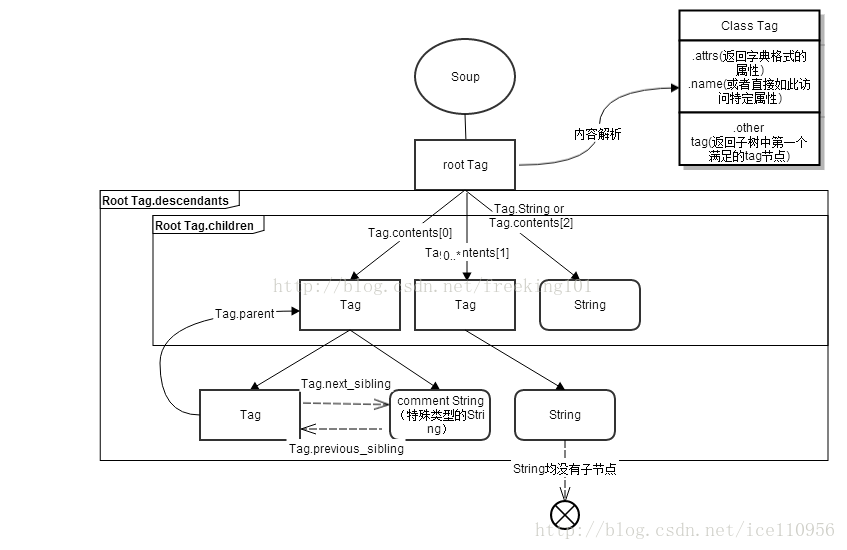
Beautiful Soup将复杂HTML文档转换成一个复杂的树形结构,每个节点都是Python对象,所有对象可以归纳为4种:
- Tag
- NavigableString
- BeautifulSoup
- Comment
(1)Tag Tag 是什么?通俗点讲就是 HTML 中的一个个标签,例如
<title>The Dormouse's story</title>
<a class="sister" href="http://example.com/elsie" id="link1">Elsie</a>
上面的 title a 等等 HTML 标签加上里面包括的内容就是 Tag,下面我们来感受一下怎样用 Beautiful Soup 来方便地获取 Tags
print soup.title
#<title>The Dormouse's story</title>

print soup.head
#<head><title>The Dormouse's story</title></head>

print soup.a
#<a class="sister" href="http://example.com/elsie" id="link1"><!-- Elsie --></a>

print soup.p
#<p class="title" name="dromouse"><b>The Dormouse's story</b></p>
利用 soup加标签名轻松地获取这些标签的内容,是不是感觉比正则表达式方便多了?不过有一点是,它查找的是在所有内容中的第一个符合要求的标签,如果要查询所有的标签,我们在后面进行介绍。 soup.title 得到的是title标签,soup.p 得到的是文档中的第一个p标签,要想得到所有标签,得用find_all函数。 find_all 函数返回的是一个序列,可以对它进行循环,依次得到想到的东西.。 对于 Tag,它有两个重要的属性,是 name 和 attrs name soup 对象本身比较特殊,它的 name 即为 [document],对于其他内部标签,输出的值便为标签本身的名称。
print soup.name
print soup.head.name
#[document]
#head
在这里,我们把 p 标签的所有属性打印输出了出来,得到的类型是一个字典。如果我们想要单独获取某个属性,可以这样,例如我们获取它的 class 叫什么
print soup.p.attrs
#{'class': ['title'], 'name': 'dromouse'}
print soup.p['class']
#['title']
print soup.p.get('class')
#['title']
我们可以对这些属性和内容等等进行修改,例如
soup.p['class']="newClass"
print soup.p
#<p class="newClass" name="dromouse"><b>The Dormouse's story</b></p>


del soup.p['class']
print soup.p
#<p name="dromouse"><b>The Dormouse's story</b></p>

head = soup.find('head')
#head = soup.head
#head = soup.contents[0].contents[0]
print head

html = soup.contents[0]       # <html> ... </html>
head = html.contents[0]       # <head> ... </head>
body = html.contents[1]       # <body> ... </body>
(2) NavigableString 既然我们已经得到了标签的内容,那么问题来了,我们要想获取标签内部的文字怎么办呢?很简单,用 .string 即可,例如
print soup.p.string
#The Dormouse's story

print type(soup.p.string)
#<class 'bs4.element.NavigableString'>
(3) BeautifulSoup BeautifulSoup 对象表示的是一个文档的全部内容.大部分时候,可以把它当作 Tag 对象,是一个特殊的 Tag,我们可以分别获取它的类型,名称,以及属性来感受一下
print type(soup.name)
#<type 'unicode'>
print soup.name
# [document]
print soup.attrs
#{} 空字典
(4) Comment Comment 对象是一个特殊类型的 NavigableString 对象,其实输出的内容仍然不包括注释符号,但是如果不好好处理它,可能会对我们的文本处理造成意想不到的麻烦。
print soup.a
print soup.a.string
print type(soup.a.string)
a 标签里的内容实际上是注释,但是如果我们利用 .string 来输出它的内容,我们发现它已经把注释符号去掉了,所以这可能会给我们带来不必要的麻烦。 另外我们打印输出下它的类型,发现它是一个 Comment 类型,所以,我们在使用前最好做一下判断,判断代码如下
if type(soup.a.string)==bs4.element.Comment:
    print soup.a.string
5. 遍历文档树
5.1 直接子节点
Tag.Tag_child1:直接通过下标名称访问子节点。 Tag.contents:以列表形式返回所有子节点。 Tag.children:生成器,可用于循环访问:for child in Tag.children 要点:.contents .children 属性 .contents tag 的 .content 属性可以将tag的子节点以列表的方式输出。可以使用 [num] 的形式获得。使用contents向后遍历树,使用parent向前遍历树
print soup.head.contents
#[<title>The Dormouse's story</title>]
print soup.head.contents[0]
#<title>The Dormouse's story</title>
.children 它返回的不是一个 list,不过我们可以通过遍历获取所有子节点。我们打印输出 .children 看一下,可以发现它是一个 list 生成器对象。 可以使用list可以将其转化为列表。当然可以使用for 语句遍历里面的孩子。
print soup.head.children
#<listiterator object at 0x7f71457f5710>
for child in  soup.body.children:
    print child
5.2 所有子孙节点
.descendants .contents 和 .children 属性仅包含tag的直接子节点,.descendants 属性可以对所有tag的子孙节点进行递归循环,和 children类似,我们也需要遍历获取其中的内容。 Tag.descendants:生成器,可用于循环访问:for des inTag.descendants
for child in soup.descendants:
    print child
5.3 节点内容
Tag.String:Tag只有一个String子节点是,可以这么访问,否则返回None Tag.Strings:生成器,可用于循环访问:for str in Tag.Strings 如果tag只有一个 NavigableString 类型子节点,那么这个tag可以使用 .string 得到子节点。如果一个tag仅有一个子节点,那么这个tag也可以使用 .string 方法,输出结果与当前唯一子节点的 .string 结果相同。通俗点说就是:如果一个标签里面没有标签了,那么 .string 就会返回标签里面的内容。如果标签里面只有唯一的一个标签了,那么 .string 也会返回最里面的内容。如果超过一个标签的话,那么就会返回None。例如
print soup.head.string
#The Dormouse's story
print soup.title.string
#The Dormouse's story
如果tag包含了多个子节点,tag就无法确定,string 方法应该调用哪个子节点的内容, .string 的输出结果是 None
print soup.html.string
# None
5.4 多个内容
.strings 获取多个内容,不过需要遍历获取,比如下面的例子
for string in soup.strings:
    print(repr(string))
    # u"The Dormouse's story"
    # u'\n\n'
    # u"The Dormouse's story"
    # u'\n\n'
    # u'Once upon a time there were three little sisters; and their names were\n'
    # u'Elsie'
    # u',\n'
    # u'Lacie'
    # u' and\n'
    # u'Tillie'
    # u';\nand they lived at the bottom of a well.'
    # u'\n\n'
    # u'...'
    # u'\n'
.stripped_strings 输出的字符串中可能包含了很多空格或空行,使用 .stripped_strings 可以去除多余空白内容
for string in soup.stripped_strings:
    print(repr(string))
    # u"The Dormouse's story"
    # u"The Dormouse's story"
    # u'Once upon a time there were three little sisters; and their names were'
    # u'Elsie'
    # u','
    # u'Lacie'
    # u'and'
    # u'Tillie'
    # u';\nand they lived at the bottom of a well.'
    # u'...'
5.5 父节点
使用parent获取父节点。 Tag.parent:父节点 Tag.parents:父到根的所有节点
body = soup.body
html = body.parent             # html是body的父亲
p = soup.p
print p.parent.name
#body

content = soup.head.title.string
print content.parent.name
#title
5.6 全部父节点
通过元素的 .parents 属性可以递归得到元素的所有父辈节点,例如
content = soup.head.title.string
for parent in  content.parents:
    print parent.name

title
head
html
[document]
5.7 兄弟节点
使用nextSibling, previousSibling获取前后兄弟 Tag.next_sibling Tag.next_siblings Tag.previous_sibling Tag.previous_siblings 兄弟节点可以理解为和本节点处在统一级的节点,.next_sibling 属性获取了该节点的下一个兄弟节点,.previous_sibling 则与之相反,如果节点不存在,则返回 None。 注意:实际文档中的tag的 .next_sibling 和 .previous_sibling 属性通常是字符串或空白,因为空白或者换行也可以被视作一个节点,所以得到的结果可能是空白或者换行
print soup.p.next_sibling
#       实际该处为空白
print soup.p.prev_sibling
#None   没有前一个兄弟节点,返回 None
print soup.p.next_sibling.next_sibling
#<p class="story">Once upon a time there were three little sisters; and their names were
#<a class="sister" href="http://example.com/elsie" id="link1"><!-- Elsie --></a>,
#<a class="sister" href="http://example.com/lacie" id="link2">Lacie</a> and
#<a class="sister" href="http://example.com/tillie" id="link3">Tillie</a>;
#and they lived at the bottom of a well.</p>
#下一个节点的下一个兄弟节点是我们可以看到的节点
.next方法:只能针对单一元素进行.next,或者说是对contents列表元素的挨个清点。
比如
soup.contents[1]=u'HTML'
soup.contents[2]=u'\n'
则soup.contents[1].next等价于soup.contents[2]
head = body.previousSibling    # head和body在同一层,是body的前一个兄弟
p1 = body.contents[0]          # p1, p2都是body的儿子,我们用contents[0]取得p1
p2 = p1.nextSibling            # p2与p1在同一层,是p1的后一个兄弟, 当然body.content[1]也可得到
contents[]的灵活运用也可以寻找关系节点,寻找祖先或者子孙可以采用findParent(s), findNextSibling(s), findPreviousSibling(s)
5.8 全部兄弟节点
通过 .next_siblings 和 .previous_siblings 属性可以对当前节点的兄弟节点迭代输出
for sibling in soup.a.next_siblings:
    print(repr(sibling))
    # u',\n'
    # <a class="sister" href="http://example.com/lacie" id="link2">Lacie</a>
    # u' and\n'
    # <a class="sister" href="http://example.com/tillie" id="link3">Tillie</a>
    # u'; and they lived at the bottom of a well.'
    # None
5.9 前后节点
与 .next_sibling .previous_sibling 不同,它并不是针对于兄弟节点,而是在所有节点,不分层次。比如 head 节点为
<head><title>The Dormouse's story</title></head>
那么它的下一个节点便是 title,它是不分层次关系的
print soup.head.next_element
#<title>The Dormouse's story</title>
5.10 所有前后节点
通过 .next_elements 和 .previous_elements 的迭代器就可以向前或向后访问文档的解析内容,就好像文档正在被解析一样
for element in last_a_tag.next_elements:
    print(repr(element))
# u'Tillie'
# u';\nand they lived at the bottom of a well.'
# u'\n\n'
# <p class="story">...</p>
# u'...'
# u'\n'
# None
6. 搜索文档树
6.1 find_all()
find_all( name , attrs , recursive , text , **kwargs ) find_all() 方法搜索当前tag的所有tag子节点,并判断是否符合过滤器的条件 1)name 参数 name 参数可以查找所有名字为 name 的tag,字符串对象会被自动忽略掉
#第一个参数为Tag的名称
tag.find_all(‘title’)
#得到”<title>&%^&*</title>”,结果为一个列表

第二个参数为匹配的属性
tag.find_all(“title”,class=”sister”)
#得到如”<title class = “sister”>%^*&</title>

# 第二个参数也可以为字符串,得到字符串匹配的结果
tag.find_all(“title”,”sister”)
#得到如”<title class = “sister”>%^*&</title>
A.传字符串 最简单的过滤器是字符串.在搜索方法中传入一个字符串参数,Beautiful Soup会查找与字符串完整匹配的内容,下面的例子用于查找文档中所有的<b>标签
soup.find_all('b')
# [<b>The Dormouse's story</b>]

print soup.find_all('a')
#[<a class="sister" href="http://example.com/elsie" id="link1"><!-- Elsie --></a>, <a class="sister" href="http://example.com/lacie" id="link2">Lacie</a>, <a class="sister" href="http://example.com/tillie" id="link3">Tillie</a>]
B.传正则表达式 如果传入正则表达式作为参数,Beautiful Soup会通过正则表达式的 match() 来匹配内容.下面例子中找出所有以b开头的标签,这表示<body>和<b>标签都应该被找到
import re
for tag in soup.find_all(re.compile("^b")):
    print(tag.name)
# body
# b
C.传列表 如果传入列表参数,Beautiful Soup会将与列表中任一元素匹配的内容返回.下面代码找到文档中所有<a>标签和<b>标签
soup.find_all(["a", "b"])
# [<b>The Dormouse's story</b>,
#  <a class="sister" href="http://example.com/elsie" id="link1">Elsie</a>,
#  <a class="sister" href="http://example.com/lacie" id="link2">Lacie</a>,
#  <a class="sister" href="http://example.com/tillie" id="link3">Tillie</a>]
D.传 True True 可以匹配任何值,下面代码查找到所有的tag,但是不会返回字符串节点
for tag in soup.find_all(True):
    print(tag.name)
# html
# head
# title
# body
# p
# b
# p
# a
# a
E.传方法 如果没有合适过滤器,那么还可以定义一个方法,方法只接受一个元素参数 [4] ,如果这个方法返回 True 表示当前元素匹配并且被找到,如果不是则反回 False。下面方法校验了当前元素,如果包含 class 属性却不包含 id 属性,那么将返回 True:
def has_class_but_no_id(tag):
    return tag.has_attr('class') and not tag.has_attr('id')


soup.find_all(has_class_but_no_id)
# [<p class="title"><b>The Dormouse's story</b></p>,
#  <p class="story">Once upon a time there were...</p>,
#  <p class="story">...</p>]
2)keyword 参数 注意:如果一个指定名字的参数不是搜索内置的参数名,搜索时会把该参数当作指定名字tag的属性来搜索,如果包含一个名字为 id 的参数,Beautiful Soup会搜索每个tag的”id”属性
soup.find_all(id='link2')
# [<a class="sister" href="http://example.com/lacie" id="link2">Lacie</a>]
如果传入 href 参数,Beautiful Soup会搜索每个tag的”href”属性
soup.find_all(href=re.compile("elsie"))
# [<a class="sister" href="http://example.com/elsie" id="link1">Elsie</a>]
使用多个指定名字的参数可以同时过滤tag的多个属性
soup.find_all(href=re.compile("elsie"), id='link1')
# [<a class="sister" href="http://example.com/elsie" id="link1">three</a>]
在这里我们想用 class 过滤,不过 class 是 python 的关键词,这怎么办?加个下划线就可以
soup.find_all("a", class_="sister")
# [<a class="sister" href="http://example.com/elsie" id="link1">Elsie</a>,
# <a class="sister" href="http://example.com/lacie" id="link2">Lacie</a>,
# <a class="sister" href="http://example.com/tillie" id="link3">Tillie</a>]
有些tag属性在搜索不能使用,比如HTML5中的 data-* 属性
data_soup = BeautifulSoup('<div data-foo="value">foo!</div>')
data_soup.find_all(data-foo="value")
# SyntaxError: keyword can't be an expression
但是可以通过 find_all() 方法的 attrs 参数定义一个字典参数来搜索包含特殊属性的tag
data_soup.find_all(attrs={"data-foo": "value"})
# [<div data-foo="value">foo!</div>]
3)text 参数 通过 text 参数可以搜搜文档中的字符串内容.与 name 参数的可选值一样, text 参数接受 字符串 , 正则表达式 , 列表, True
soup.find_all(text="Elsie")
# [u'Elsie']

soup.find_all(text=["Tillie", "Elsie", "Lacie"])
# [u'Elsie', u'Lacie', u'Tillie']

soup.find_all(text=re.compile("Dormouse"))
[u"The Dormouse's story", u"The Dormouse's story"]
4)limit 参数 find_all() 方法返回全部的搜索结构,如果文档树很大那么搜索会很慢.如果我们不需要全部结果,可以使用 limit 参数限制返回结果的数量.效果与SQL中的limit关键字类似,当搜索到的结果数量达到 limit 的限制时,就停止搜索返回结果. 文档树中有3个tag符合搜索条件,但结果只返回了2个,因为我们限制了返回数量
soup.find_all("a", limit=2)
# [<a class="sister" href="http://example.com/elsie" id="link1">Elsie</a>,
#  <a class="sister" href="http://example.com/lacie" id="link2">Lacie</a>]
5)recursive 参数 调用tag的 find_all() 方法时,Beautiful Soup会检索当前tag的所有子孙节点,如果只想搜索tag的直接子节点,可以使用参数 recursive=False 。一段简单的文档:
<html>
 <head>
  <title>
   The Dormouse's story
  </title>
 </head>
...
是否使用 recursive 参数的搜索结果:
soup.html.find_all("title")
# [<title>The Dormouse's story</title>]

soup.html.find_all("title", recursive=False)
# []
6.2 find()
find(name=None, attrs={}, recursive=True, text=None, **kwargs)
它与 find_all() 方法唯一的区别是 find_all() 方法的返回结果是值包含一个元素的列表,而 find() 方法直接返回结果。
.find('p'),.findAll('p'):find返回的是字符串值,而且是返回从头查找到的第一个tag对。但是如果这第一个tag对包括大量的内容,父等级很高,则同时其内部所包含的,此级标签也全部都find。findAll返回值是个列表,如果发现了一个同名标签内含多个同名标签,则内部的标签一并归于该父标签显示,列表其他元素也不再体现那些内含的同名子标签。即findAll会返回所有符合要求的结果,并以list返回。
soup.findAll(οnclick='document.location...')
    soup.findAll(attrs={'style':r'outline:none;'}) #用来查找属性中有style='outline:none;的标签体。                                 # 搜索所有tag
tag搜索
find(tagname)                                  # 直接搜索名为tagname的tag 如:find('head')
find(list)                                     # 搜索在list中的tag,如: find(['head', 'body'])
find(dict)                                     # 搜索在dict中的tag,如:find({'head':True, 'body':True})
find(re.compile(''))                           # 搜索符合正则的tag, 如:find(re.compile('^p')) 搜索以p开头的tag
find(lambda)                       # 搜索函数返回结果为true的tag, 如:find(lambda name: if len(name) == 1) 搜索长度为1的tag
find(True)                                     # 搜索所有tag

attrs搜索
find(id='xxx')                                  # 寻找id属性为xxx的
find(attrs={id=re.compile('xxx'), algin='xxx'}) # 寻找id属性符合正则且algin属性为xxx的
find(attrs={id=True, algin=None})               # 寻找有id属性但是没有algin属性的

resp1 = soup.findAll('a', attrs = {'href': match1})
resp2 = soup.findAll('h1', attrs = {'class': match2})
resp3 = soup.findAll('img', attrs = {'id': match3})

text搜索
   文字的搜索会导致其他搜索给的值如:tag, attrs都失效。方法与搜索tag一致
print p1.text
# u'This is paragraphone.'
print p2.text
# u'This is paragraphtwo.'
# 注意:1,每个tag的text包括了它以及它子孙的text。2,所有text已经被自动转为unicode,如果需要,可以自行转码encode(xxx)

recursive和limit属性
recursive=False表示只搜索直接儿子,否则搜索整个子树,默认为True。
当使用findAll或者类似返回list的方法时,limit属性用于限制返回的数量,
如:findAll('p', limit=2): 返回首先找到的两个tag
6.3 find_parents() find_parent()
find_all() 和 find() 只搜索当前节点的所有子节点,孙子节点等. find_parents() 和 find_parent() 用来搜索当前节点的父辈节点,搜索方法与普通tag的搜索方法相同,搜索文档搜索文档包含的内容
6.4 find_next_siblings() find_next_sibling()
这2个方法通过 .next_siblings 属性对当 tag 的所有后面解析的兄弟 tag 节点进行迭代, find_next_siblings() 方法返回所有符合条件的后面的兄弟节点,find_next_sibling() 只返回符合条件的后面的第一个tag节点
6.5 find_previous_siblings() find_previous_sibling()
这2个方法通过 .previous_siblings 属性对当前 tag 的前面解析的兄弟 tag 节点进行迭代, find_previous_siblings()方法返回所有符合条件的前面的兄弟节点, find_previous_sibling() 方法返回第一个符合条件的前面的兄弟节点
6.6find_all_next() find_next()
这2个方法通过 .next_elements 属性对当前 tag 的之后的 tag 和字符串进行迭代, find_all_next() 方法返回所有符合条件的节点, find_next() 方法返回第一个符合条件的节点
6.7 find_all_previous() 和 find_previous()
这2个方法通过 .previous_elements 属性对当前节点前面的 tag 和字符串进行迭代, find_all_previous() 方法返回所有符合条件的节点, find_previous()方法返回第一个符合条件的节点
7. CSS选择器
在这里我们也可以利用类似的方法来筛选元素,用到的方法是 soup.select(),返回类型是 list
7.1 通过标签名查找
print soup.select('title')
#[<title>The Dormouse's story</title>]

print soup.select('a')
#[<a class="sister" href="http://example.com/elsie" id="link1"><!-- Elsie --></a>, <a class="sister" href="http://example.com/lacie" id="link2">Lacie</a>, <a class="sister" href="http://example.com/tillie" id="link3">Tillie</a>]

print soup.select('b')
#[<b>The Dormouse's story</b>]
7.2 通过类名查找
print soup.select('.sister')
#[<a class="sister" href="http://example.com/elsie" id="link1"><!-- Elsie --></a>, <a class="sister" href="http://example.com/lacie" id="link2">Lacie</a>, <a class="sister" href="http://example.com/tillie" id="link3">Tillie</a>]
7.3 通过id名查找
print soup.select('#link1')
#[<a class="sister" href="http://example.com/elsie" id="link1"><!-- Elsie --></a>]
7.4 组合查找
组合查找即和写 class 文件时,标签名与类名、id名进行的组合原理是一样的, 例如:查找 p 标签中,id 等于 link1的内容,二者需要用空格分开
print soup.select('p #link1')
#[<a class="sister" href="http://example.com/elsie" id="link1"><!-- Elsie --></a>]
直接子标签查找
print soup.select("head > title")
#[<title>The Dormouse's story</title>]
7.5 属性查找
查找时还可以加入属性元素,属性需要用中括号括起来,注意属性和标签属于同一节点,所以中间不能加空格,否则会无法匹配到。
print soup.select('a[class="sister"]')
#[<a class="sister" href="http://example.com/elsie" id="link1"><!-- Elsie --></a>, <a class="sister" href="http://example.com/lacie" id="link2">Lacie</a>, <a class="sister" href="http://example.com/tillie" id="link3">Tillie</a>]

print soup.select('a[href="http://example.com/elsie"]')
#[<a class="sister" href="http://example.com/elsie" id="link1"><!-- Elsie --></a>]
同样,属性仍然可以与上述查找方式组合,不在同一节点的空格隔开,同一节点的不加空格
print soup.select('p a[href="http://example.com/elsie"]')
#[<a class="sister" href="http://example.com/elsie" id="link1"><!-- Elsie --></a>]
以上的 select 方法返回的结果都是列表形式,可以遍历形式输出,然后用 get_text() 方法来获取它的内容。
soup = BeautifulSoup(html, 'lxml')
print type(soup.select('title'))
print soup.select('title')[0].get_text()

for title in soup.select('title'):
    print title.get_text()
这就是另一种与 find_all 方法有异曲同工之妙的查找方法。
print soup.find_all("a", class_="sister")
print soup.select("p.title")

# 通过属性进行查找
print soup.find_all("a", attrs={"class": "sister"})

# 通过文本进行查找
print soup.find_all(text="Elsie")
print soup.find_all(text=["Tillie", "Elsie", "Lacie"])

# 限制结果个数
print soup.find_all("a", limit=2)
参考
- https://jianshu.com/p/f0f4c253bb14
- https://blog.csdn.net/love666666shen/article/details/77512353